

How do I choose a solar system that can meet my requirements?
1) Home use (5kw and 10kw)
In a family of about 3 bedrooms, more people choose 5KW and 10KW models.If you want to choose a high-quality system, we suggest to choose the IGBT high-end inverter, and use it more safely.
2) School and office (1.5kw-5kw) Angola, Senegal, Zimbabwe installation
3) Farm use (three-phase 10KW-20KW) Thailand and Australia installation
4) Hospital project (15kw) Somalia, Kenya installation
5) Government office building (80kw) Kenya Konza City installation
6) Factory project (100kw) Haiti installation
7) Airport project (60KW-200KW) Indonesia, Papua New Guinea installation
8) Large shopping mall (150KW) Iraq installation
9) Village power generation (300kw) Zambia installation
If you want to know more cases, please go to OSM’s official website or contact us. Based on years of actual installation experience, we can definitely provide a solar power system that will satisfy you.
| Product Description |
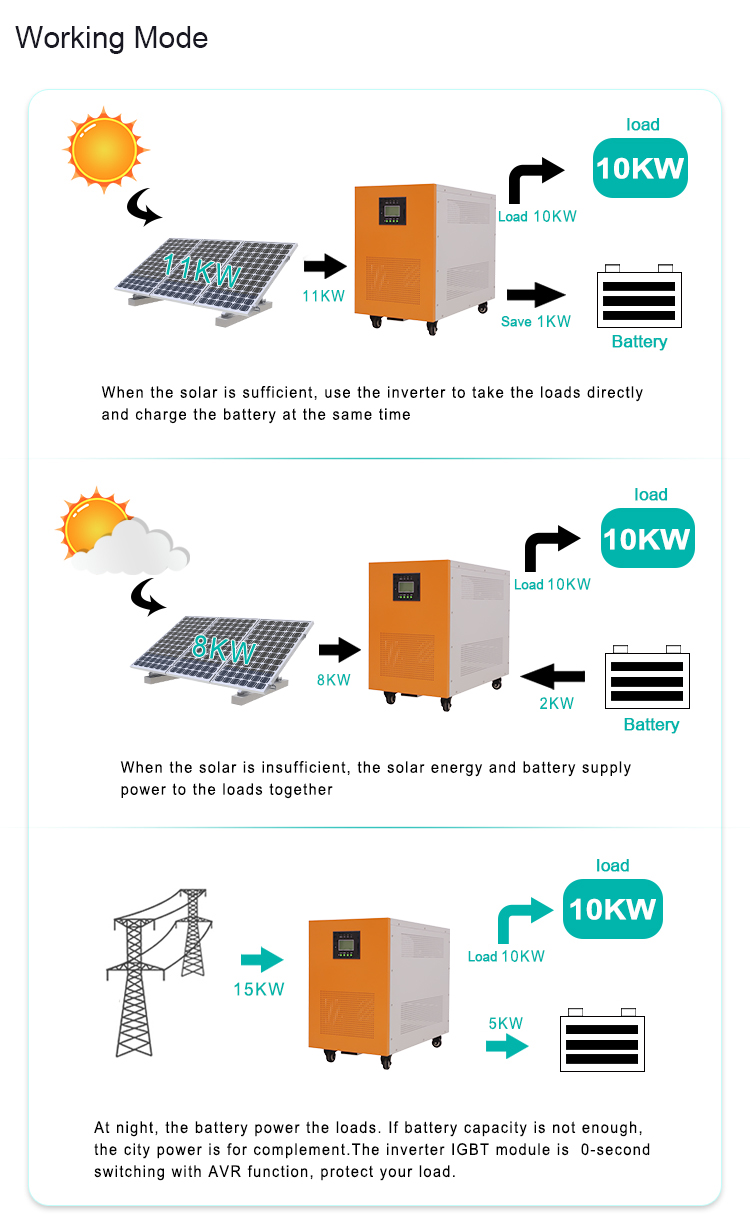
How the off grid solar generator system working:
This Solar system not only have solar power system function, but also have Utility complementary function. When main power off , the solar system can switch automatically to take use off solar power from battery to run load, When solar power not enough and power off , it can switch automatically to main power and connect with grid electricity take use of main power, at the same time charging battery. This is very suit for home use.
What’s the difference between off grid and on grid solar power system?
Off-grid solar power generator system doesn’t connect to the power grid. In general, it includes solar panels, charger controller, batteries and inverter. This system will store the solar power into the batteries, batteries energy will be converted the electricity power to supply the appliances working through the inverter.
On-grid solar power system connects to the power grid, can sell excess electricity to the public grid. In general, it includes solar panels, grid-tie inverter, the solar power will be converted the electricity power to appliance working directly. When the solar power is off, the power grid will replenish the electricity power to appliances working.

Leave A Comment