

Off-grid energy storage system
An off-grid system consists of the following components: Battery modules, photovoltaic charge and discharge controllers, battery packs, off-grid inverters, AC/DC loads.
- The main function of the photovoltaic charge and discharge controller is to control the charging and discharging of the battery, and to protect the battery from overcharging and discharging.
- Off-grid inverter, the function of an off-grid inverter is to convert DC power into AC power and provide it to the device used by the load.
Our common off-grid energy storage system is solar streetlights. Photovoltaic modules, a controller the size of a cigarette box, a ten of watt LED light, one or several sets of batteries. It can provide night lighting.
Grid-connected energy storage system
The energy storage power station (system) mainly cooperates with photovoltaic grid-connected power generation applications. Therefore, the entire system includes a photovoltaic module array, photovoltaic controller, battery pack, battery management system (BMS), inverter, and the corresponding energy storage power station joint control and dispatch power generation systems, etc.
The photovoltaic module array uses the photovoltaic effect of the solar panel to convert light energy into electric energy, and then charges the lithium battery pack, and converts the direct current into alternating current through the inverter to supply power to the load; the intelligent controller continuously changes according to the change of the sunlight intensity and the load. Switch and adjust the working state of the battery pack: on the one hand, the adjusted electric energy is directly sent to the DC or AC load. On the other hand, the excess electric energy is sent to the battery pack for storage. When the power generation cannot meet the needs of the load, the controller sends the electric energy of the battery to the load to ensure the continuity and stability of the entire system. The energy storage battery OSM battery company currently provides 5KWH, 10KWH, wall-mounted, and stacked styles of energy walls.
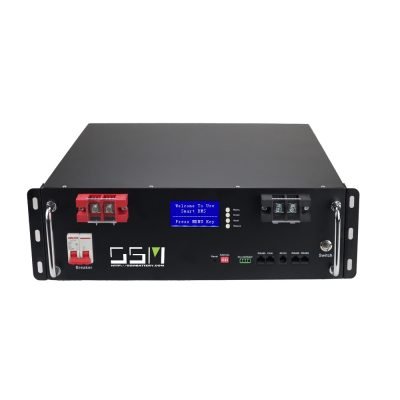
Rack mount modules 3.5U 48V 100Ah
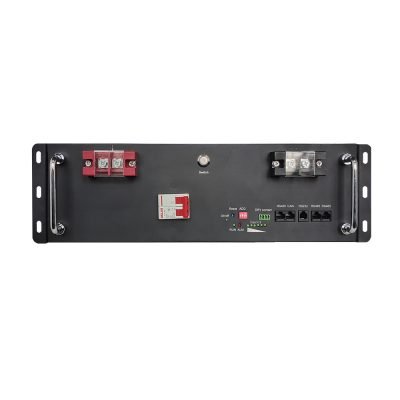
19″ Rack Mount lithium Battery 3U module
The energy storage battery meets the requirements
Easy to realize multimode combination, to meet the higher working voltage and larger working current; The capacity and performance of the battery can be detected and diagnosed, so that the control system can realize the scheduling control of the power station load under the condition of predicting the capacity and performance of the battery. High safety and reliability: in normal use, the normal service life of the battery is not less than 15 years; OSM Battery is currently CE certified and the safety of the battery is guaranteed. They now sell all over the world.
In the limit case, even if the failure occurs, it is in the controlled range, and the failure that endangers the safe operation of the power station, such as explosion and combustion, should not occur. Has a good fast response and large rate charge and discharge capacity, generally requires 5-10 times of charge and discharge capacity; High charge-discharge conversion efficiency; Easy to install and maintain; It has better environmental adaptability and wide working temperature range.
Several battery performance comparison
In terms of initial investment costs, lithium-ion batteries have a strong competitive edge, while sodium-sulfur and all-vanadium liquid flow batteries are not industrialized and have restricted supply channels and are more expensive. In terms of operation and maintenance costs, sodium-sulfur requires continuous heating, and all-vanadium liquid flow batteries require pumps for fluid control, which increases operation costs, while lithium batteries require almost no maintenance. According to the current situation of domestic and foreign energy storage power plant applications and battery characteristics, it is recommended that the battery selection for energy storage power plant is mainly lithium iron phosphate batteries. The reason for not recommending the use of lead-acid batteries is the battery life problem, the big brand lead-acid batteries in the case of frequent charging and discharging about only 2.5-3 years of life, the life of lithium batteries will be much longer.